
Preliminary insights from the EDU-LAB pathways framework
The transition from education to employment is oftentimes perceived as a simple step from finishing your studies and going into the labour market. However, recent research findings increasingly show that young people’s transitions are rarely linear; rather, they are characterised by diverse educational and career paths, various decision-making phases, and a multitude of influencing factors.
During its first year, the Horizon Europe project EDU-LAB – European Youth in Transition to Education and Labour developed a conceptual framework designed to provide a better understanding of how young people navigate education and training systems and ultimately enter the labour market. Deliverable D1.1 provides a systematic mapping of the different educational pathways, forms of transition and influencing factors that shape and structure these processes.
The conceptual framework makes it clear that young people’s transitions should not be understood as isolated events, but rather as dynamic and multidimensional processes influenced by individual circumstances, institutional structures and overarching socio-economic conditions.
Transitions for young people encompass a wide range of educational and career pathways

One of the key findings of the EDU-LAB Pathways Framework is that young people do not follow a uniform or standardised path from education to employment. Instead, these transitions often involve several stages, which may include shifts between different forms of education and training, before they finally enter the labour market.
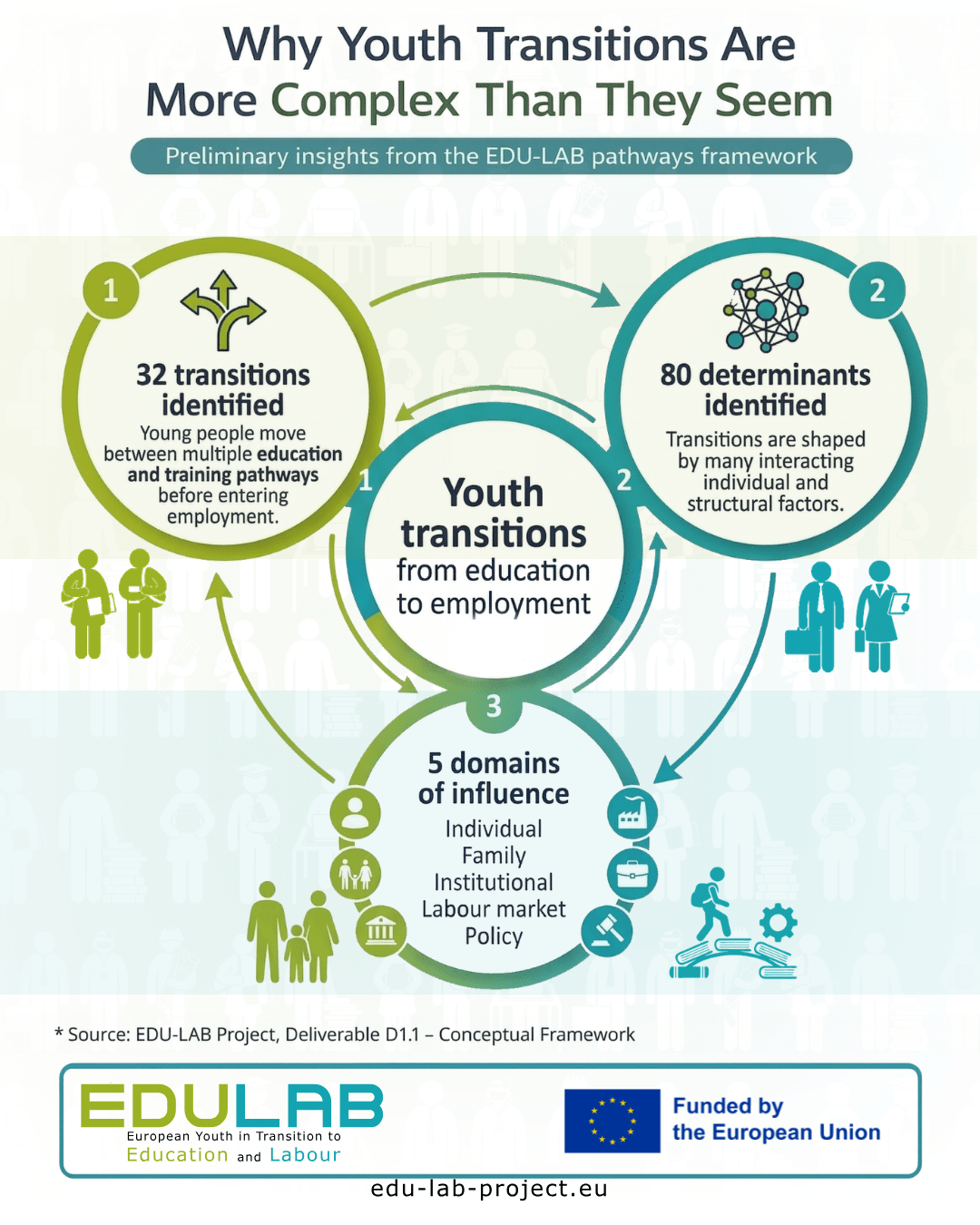
The framework identifies a total of 32 different types of transition between general education, vocational education and training (VET), and various forms of entry into the labour market. These include both movements between different educational streams and progression within educational systems, as well as the transition into employment.
This perspective highlights the importance of viewing transitions not as single points in time, but as sequences of multiple steps and decisions that can extend over longer periods.

Numerous factors influence young people’s educational and career pathways
The EDU-LAB Framework also highlights the wide range of factors that can influence how young people navigate and move within education and training systems. A total of 80 determinants have been identified, which are assigned to different spheres of influence and help shape the transition processes.
These include factors such as:
- individual characteristics and experiences
- family background and parental influence
- institutional structures within education systems
- labour-market conditions
- policy environments
The framework highlights that these factors do not usually operate in isolation, but interact with one another, thereby further increasing the complexity of transitions.
Decisions are shaped by both individual and structural influences
The EDU-LAB model also emphasises that educational and career decisions are influenced by both personal considerations and external conditions.
For example, the framework takes into account how students’ interests, their self-assessment of abilities and their expectations for the future interact with parental expectations, financial circumstances and institutional provision. At the same time, systemic factors such as entry requirements, programme structures and employment opportunities also shape the options actually available.
This is consistent with the broader academic understanding that young people’s transitions cannot be explained solely by individual decisions without also taking into account the structural contexts within which these decisions are made.
Transitions are shaped by their respective contexts
In addition to individual and institutional factors, the EDU-LAB Framework also emphasises the importance of overarching contextual conditions. These include, for example, economic developments, demographic changes and external influences that can affect education and labour market systems.
Furthermore, the framework also takes into account the role of policy measures and public investment aimed at improving access to education, promoting equal opportunities and increasing participation in education and training systems.
This perspective makes it clear that young people’s transitions should always be viewed within the context of broader systemic frameworks and cannot be understood as separate, isolated processes.
A foundation for further EDU-LAB research
As a result of the first year of the project, the EDU-LAB Pathways Framework provides a structured basis for better understanding the complexity of young people’s transitions and the multitude of factors influencing them. By systematically mapping educational pathways, forms of transition and determining factors, the approach creates an important foundation for further research within the project.
In the next project phases, EDU-LAB will build on these findings and deepen them through data analysis, consultations with experts and qualitative research, in order to better understand how these educational and career pathways are specifically structured and function in different European contexts.
Subscribe to our bi-annual newsletter and follow us on LinkedIn, Facebook, Instagram, and Bluesky to receive updates on our findings, events, and opportunities to engage with EDU-LAB.